“Hostile” Symbols & Slogans: The Attack on Palestinian Presence in Europe
By ELSC Research & Monitoring Department.
Attempts to erase Palestinian symbols and slogans from public spaces are part of a longer history of Zionist genocidal efforts not only to criminalise but to eradicate Palestinian presence itself. In this blog post, the ELSC Monitor and Research Department draws on insights from its transnational public database, the Index of Repression, to reflect on the politics of presence and disappearance of Palestinian slogans and symbols across Europe.
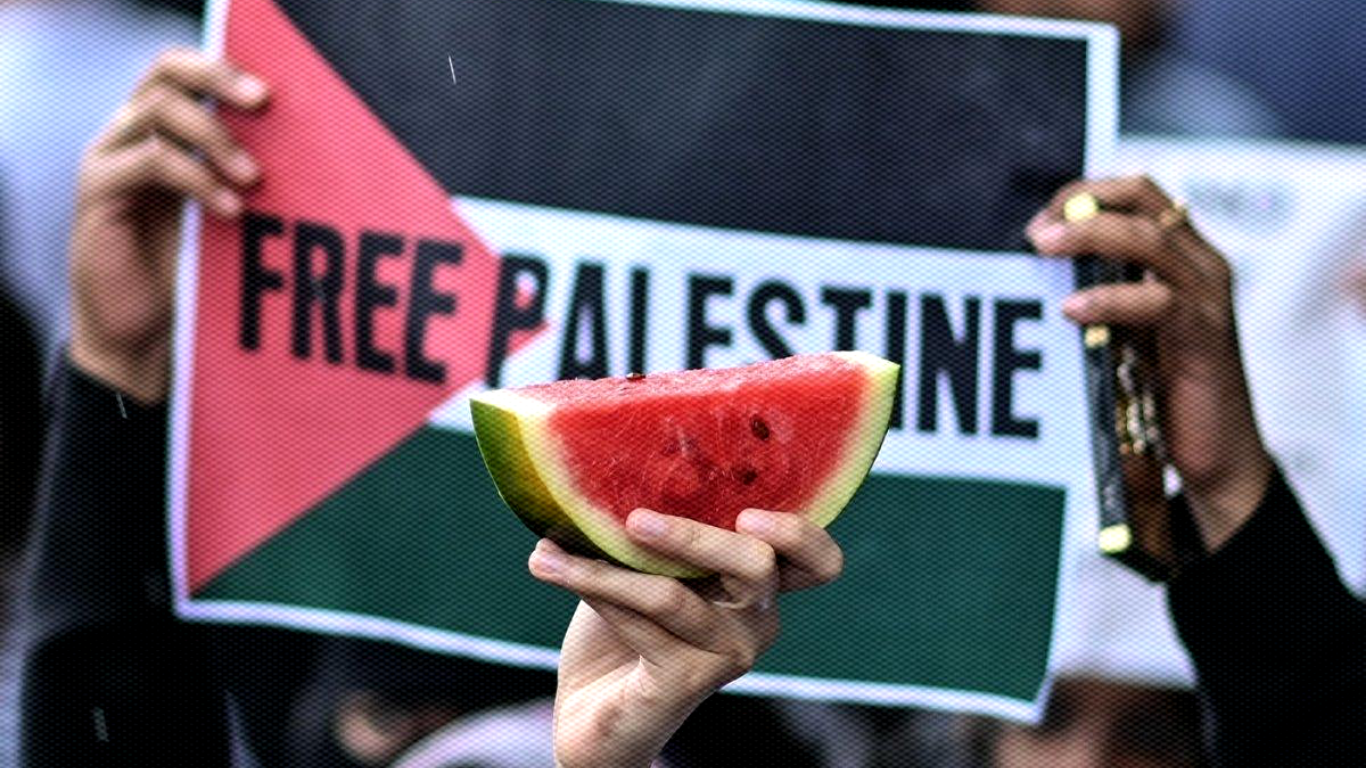
Last month, Germany’s Domestic Intelligence Agency (Verfassungsschutz) released its latest assessment on what it calls “secular pro-Palestinian extremism”, claiming that “pro-Palestinian individuals and groups in Germany” demonstrate a “pronounced hatred of Israel and antisemitism”. The list of “extremist” symbols and slogans includes Handala, a cartoon depicting “a ten-year-old barefooted, raggedly dressed homeless Palestinian refugee camp child … an icon of resistance and a symbol of homelessness and injustice”. The chant “Yalla Yalla intifada” and the “symbolism of a cut watermelon” are also listed, as well as the slogan “From the river to the sea, Palestine will be free” (FTRTTS) – all on the grounds that they might constitute “a call for violent resistance” and a denial of “Israel’s right to exist”.
What does it mean when a state criminalises the very symbols and slogans through which a dispossessed people asserts its presence? And who holds the power to decide what a symbol means?
Before the Verfassungsschutz
The criminalisation1 of Palestinian slogans in Germany did not begin with this assessment, nor with the FTRTTS slogan. But the trajectory of FTRTTS is instructive. Its policing long predates the Verfassungsschutz’s assessment, as well as its effective proscription following the November 2023 ban on Hamas and Samidoun. The phrase – which calls for liberation, return, and the end of a settler colonial system that has fragmented Palestinians and their land since 1948 – was already subject to increasing repression before any formal ban existed.
The pattern of criminalisation preceding formal law is visible in a 2022 report by the Federal Conference of Interior Ministers. The report recommended a “standardised prosecution practice” for expressions directed at “the safety or even the existence of the state of Israel”, explicitly naming FTRTTS. Individuals were already deemed suspect, arrested, and investigated for the slogan before any legal consensus on its status existed. State repression, in other words, helps produce the very legal bases that then justify further repression.
Since the 2023 proscription of Hamas and Samidoun, public use of the slogan at demonstrations, on social media, or even on items sold at Christmas markets has been prosecuted under sections 86a and 140 of the German Criminal Code.2 But German courts have issued conflicting rulings. In 2023, the Higher Administrative Court in Berlin affirmed the slogan’s prohibition, arguing that it could be interpreted as a call for the “violent elimination of the state of Israel”. In contrast, in 2024, the Higher Administrative Court in Bremen ruled that the slogan does not constitute a threat to public safety. This legal inconsistency enables broad and ambiguous practices of criminalisation because police, prosecutors, and institutions can choose to follow the stricter Berlin ruling when it suits them, while courts in other jurisdictions may impose no penalty at all. The uncertainty itself is an instrument to produce self-censorship.
Policing Memory
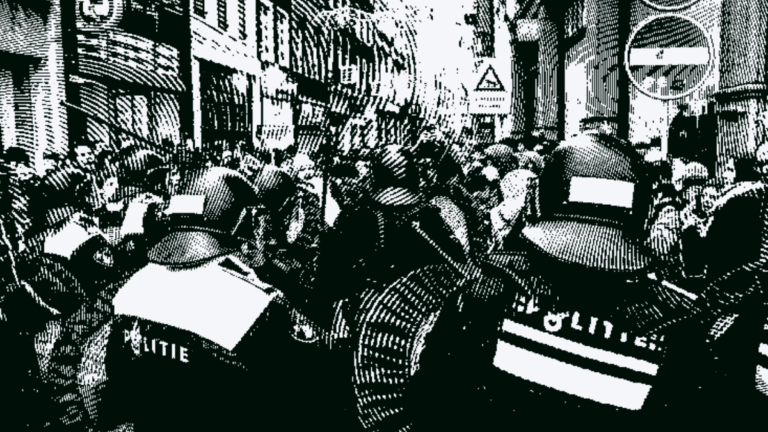
This inconsistent legal attack is only one layer of a broader assault on Palestinian political existence. Repression is also happening in public spaces where the logic of criminalisation takes on a different, often more insidious form. Commemorating the Nakba has repeatedly been banned by police and public institutions such as churches,3 and presenting oneself as Palestinian, especially in schools,4 routinely invokes social condemnation in Germany.
Memory is always a battleground over which histories are legible and which must be suppressed. Palestinian memory – of the Nakba, dispossession, ongoing genocide – exceeds the authorised narratives of German remembrance culture. It cannot be accommodated, only disciplined and policed.
This also extends into sites of anti-fascist memory. The Buchenwald Memorial Foundation published an internal guidance document that classified the Kuffiyeh as an “antisemitic” symbol. The same document listed FTRTTS, “stop the genocide”, and the watermelon. A memorial to the victims of Nazism thus became a site where the symbols of an occupied and besieged people are treated as equivalent to fascist emblems. What makes this a particularly stark inversion is that Buchenwald is also a monument to the power of liberation, where the incarcerated organised, collected weapons, and took control over the concentration camp before US troops arrived on 11 April 1945.
A Transnational Pattern of Criminalisation
Beyond Germany, the attack on Palestinian presence is systematic. As early as December 2023, British police arrested nine activists under section 18 of the Public Order Act 1986 for displaying a banner reading “globalise the intifada”.5 Last December, two people were arrested “for racially aggravated public order offences” after they allegedly “shouted slogans involving calls for intifada”. And most recently, British Prime Minister Keir Starmer declared that anyone who says “globalise the intifada” is calling for “terrorism against Jews”. In France, a verdict expected this year may outlaw the public use of the word after a founding member of the French Palestine solidarity group Urgence Palestine was charged with “incitement to antisemitic hatred and violence”.
The Arabic word intifada simply means “uprising”. It has historically been used to describe popular struggles against injustice, colonial domination, and authoritarianism. To claim that it is terrorist is a deliberate and demonstrably racist distortion that erases the way intifada has given life to a complex strategy of popular refusal. The first (1987 – 1993) and second (2000 – 2005) Palestinian uprisings were popular mobilisations against the structural and daily violence of settler colonialism. The attempt to criminalise the word is an attack against the very notion that the colonised may rise, organise, and refuse their own domination and erasure.
This pattern extends beyond words to symbols and colours. In 2025, a school in the UK dismissed a teacher for wearing a tie in the colours of the Palestinian flag, citing a breach of “duty to remain politically impartial”.6 This invocation of neutrality is itself a technique of repression because it presents the colonial order as normal, protecting the visibility of the coloniser while demanding the invisibility of the colonised.
The scale of this repression is not limited to individual cases. Our data shows the systematic nature of the attack on Palestinian symbols and slogans. The Index of Repression currently contains 94 incidents that criminalise and smear FTRTTS (or variations thereof) as support for terrorism in Germany. Although the same slogan is not banned in Britain, it appears several times in the British dataset.7 Wearing the Kuffiyeh has resulted in repressive acts 49 times in Germany and 11 times in Britain.8i Across Europe, the universe of banned symbols and slogans continues to expand.
What Is Really at Stake?
Palestinian erasure happens on multiple fronts. In Gaza, the Zionist military is carrying out a genocide – the material manifestation of the negation of Palestinian life, the most brutal expression of a century-old project to erase a people from land, memory, and futurity. But negation does not operate only through bombs, bullets, and blockade. It also happens through the destruction of the very fabric that makes shared identity possible: symbols, words, memories, the right to appear – to be present – in public. Symbols and slogans are one important thread that holds Palestinianness together across time and space
The 1948 Nakba was one of the first instances of distortion, and the beginning of a long process in which Palestinian life would be refigured, resignified, and weaponised. The struggle ever since has been over who gets to rule, to narrate, to belong. A struggle that Palestinians never relinquished.
The genocide in Gaza is the material core of negation, and the symbolic assault unfolding in Europe is not merely a distraction but a front in the same struggle. More than anything, what is at stake is the erasure of the Palestinian people and their historic struggle for land and dignity. While this assault on Palestinianness exposes the hypocrisies of European democracy – the hollowing out of free expression, the weaponisation of “antisemitism” and “terrorism” allegations – the real cause remains Palestine.
The Logic of Disappearance
The attack on Palestinian symbols and slogans are experiments that test how far state and non-state institutions can go in banning fragments of Palestinian life. This logic serves several functions.
First, the goal is to make Palestinians disappear from public life through bureaucratic, legal, and social mechanisms. Second, there is a consistent lowering of the threshold of criminalisation. The goal is to produce a climate of fear so that individuals and institutions enact self-censorship before the law even enforces silence. Third, this attack functions as a distortion of history. The reframing of Palestinian symbols and slogans of resistance as inherently violent is an attempt by European institutions to excise them from the struggle from which they emerge. Fourth, this redefinition produces the coloniser as innocent, so that Zionism appears morally blameless while Europe positions itself as the defender of liberal values.
These functions rely on the authority to decide what a symbol or slogan means in the first place.
Who Gets to Define Meaning?
The power to decide what a symbol or slogan means is the power to decide who belongs and who does not. Repeatedly, Zionist organisations, state authorities, police forces, and courts claim the right to define Palestinian symbols and slogans – overriding the intent, history, and lived reality of the people who use them. Distorting their meaning becomes a form of knowledge production, where manufactured definitions justify repression and erasure. This is not merely a debate about interpretation, but a struggle over who has the power to fix meaning in law and public discourse.
Fixing meaning is a technology of colonial governance. When FTRTTS is declared a symbol of Hamas, its meaning is fixed, regardless of how Palestinians have used it for decades, let alone the fact that Likud once used the same words to invoke genocide. Classifying the Kuffiyeh as “antisemitic” erases its hundred-year history as peasant garb, rebel uniform, and national emblem. Fixing meaning stops a symbol or slogan from moving, from accumulating new meanings and adapting to new contexts. Once fixed, it becomes easier to criminalise because the state cannot easily ban a slogan whose meaning shifts and mutates but can ban a slogan whose meaning has been pinned down, and the same logic applies to people since a people whose identity is fixed and stripped of complexity and history is a people that can be governed, policed, and ultimately erased.
In Europe, this struggle takes on a local dimension. Police officers, state prosecutors, and courts have further added to the Zionist distortion, giving it a local inflection. Manuals produced for the Berlin police and an “Action Kit” for schoolteachers, have sought to “expose” Palestinian symbols as hidden forms of anti-Jewish racism. These documents lend legitimacy to the escalating repression, as seen in the latest assessment of the Verfassungsschutz.
Refusing Fixity
But meaning refuses to stay fixed. Just as the watermelon has been used to challenge the criminalisation of the Palestinian flag’s colours by Israeli soldiers, new versions of FTRTTS have emerged to evade European criminalisation. In Berlin, protesters have chanted “From the Risa to the Spree”, a play on words replacing “river” with “Risa”, a popular chicken shop, and “sea” with the Spree River that runs through Berlin. The slogan is absurd, and that is precisely the point. It mocks the very logic of criminalisation by exposing its limits, as a whole state institution must now debate whether demanding freedom “from the Risa to the Spree” constitutes “antisemitism”. The more attempts are made to fix meaning, the more meanings proliferate, forcing the system to catch up, issue new rulings, and expand the list of banned phrases.
These creative refusals are acts of political imagination. But legal battles are also part of the struggle. ELSC-supported litigation has challenged the criminalisation of FTRTTS, and the Buchenwald ban on the Kuffiyeh, exposing contradictions and unwritten rules of the system. Courtrooms have become spaces where not only the legality of bans has come under scrutiny, but where the multifaceted history and world-building invoked by Palestinian symbols and slogans have been discussed at length.
Conclusion
Although our work at the ELSC is focused on Europe, to treat the attack on Palestinian symbols and slogans as merely a European story is to miss its transnational character. The same slogan can be criminalised in Berlin and protected in Amsterdam.This inconsistency is a feature of a system that is still experimenting – and responding to resistances – testing how far it can go in making Palestinian life invisible. But because symbols and slogans circulate, because they travel and adapt and refuse to stay still, the experiment keeps failing. A slogan chanted in a dozen languages on every continent cannot be criminalised, and the meaning of a people who are constantly, creatively, stubbornly on the move while also persisting on their land cannot be fixed.
What we have outlined here constitutes an attack on shared identity, an attempt to make Palestinians invisible even to each other. Ordinary objects such as maps, bracelets, stickers, and scarves, represent “everyday nationhood”. They are the small, often unremarked materials through which a people recognises itself and its continuity. That is precisely why Zionism wants them gone. Yet Palestinians insist that partition and acquiescence are not liberation – return is.
ELSC Research & Monitoring Department
The ELSC Research and Monitoring Department is the investigative backbone of our work, documenting and analysing the growing threats to the Palestine solidarity movement in Europe and exposing how this repression functions as a tool to pre-emptively dismantle dissent.
Endnotes:
[1] Criminalisation here refers not only to formal bans but also to the broader web of arrests, court rulings, and institutional sanctions that make Palestinian expression legally precarious.
[2] For example, see incident INC-4107-J8M1 on the Index of Repression platform, https://www.index-of-repression.org/de/platform.
[3] For example, see incident INC-3194-T6Y9 on the Index of Repression platform, https://www.index-of-repression.org/de/platform.
[4] For example, see incident INC-3288-Q2B0 on the Index of Repression platform, https://www.index-of-repression.org/de/platform.
[5] See incident INC-1824-T8S0 on the Index of Repression platform, https://www.index-of-repression.org/uk/platform.
[6] See incident INC-2995-Z2R5 on the Index of Repression platform, https://www.index-of-repression.org/uk/platform.
[6] For example, see incident INC-2412-J8X9 on the Index of Repression platform, https://www.index-of-repression.org/uk/platform.
[8] For example, see incident INC-2933-L5J8 on the Index of Repression platform, https://www.index-of-repression.org/uk/platform.
Contribute to the Blog
We encourage contributions that provide legal analysis, political reflection, strategic insights, movement experiences, interviews, and briefings relevant to Palestine solidarity and anti-Palestinian repression across Europe.