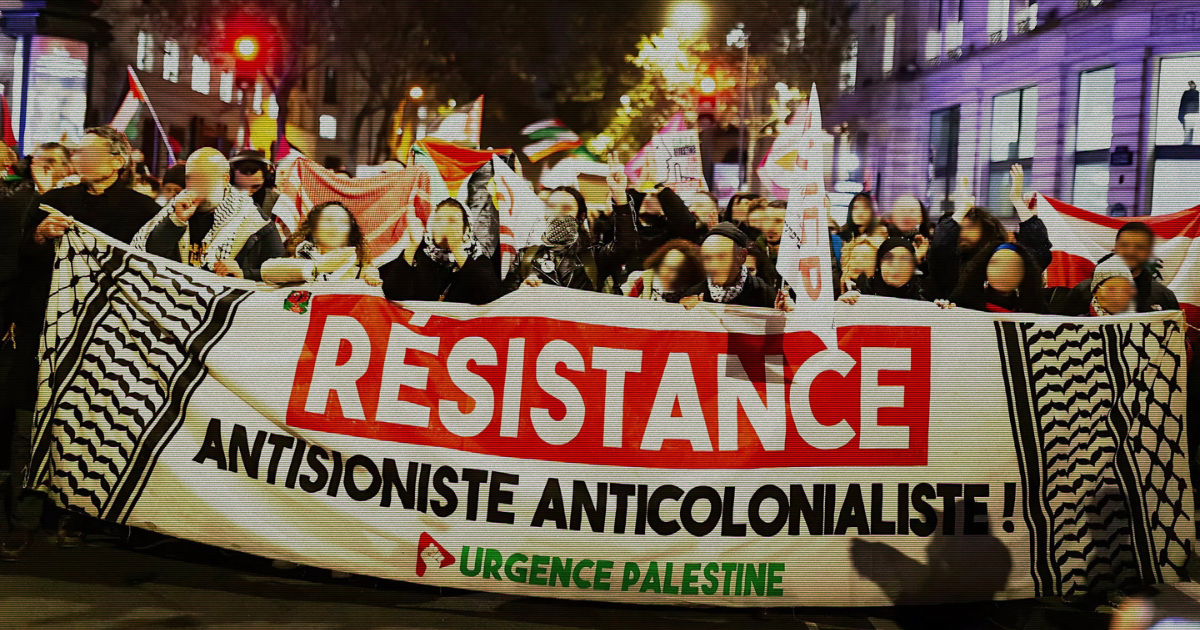
Don’t Let Them Silence The Voices of Palestine – Stand united against the ban of Urgence Palestine.
As ELSC, our mandate is to defend the solidarity movement with Palestine—always.
Over the past 20 months, repression against the Palestine Solidarity Movement and anti-genocide voices has reached unimaginable levels. At the ELSC we have documented thousands of incidents of censorship and suppression across Europe and Britain.
In April 2025, the French government crossed a dangerous line. Interior Minister Retailleau notified Urgence Palestine of the government’s intention to dissolve the group.
Criminalising and isolating Palestinian groups who stand at the center of organising and solidarity is a key tactic used by states to quash an ever-growing movement of dissent against their complicity with Israel’s genocidal campaign in Palestine.
Who We Are Defending:
Urgence Palestine is a collective founded by Palestinians in the diaspora and their closest allies in France. For the past 20 months, the collective has worked tirelessly to build a platform for political expression and mobilisation against censorship and complicity with Israel’s ongoing genocide in Gaza in a country like France, where state repression grows fiercer by the day, and anti-Arab racism and Islamophobia surge to terrifying heights.
This dissolution of UP is not an isolated act, but part of a broader strategy designed to suppress and criminalise those who refuse to be silent in the face of a live-streamed genocidal annihilation campaign.
In recent years, the French government has increasingly employed a specific legal mechanism to dissolve political organisations. This approach has targeted groups across a broad spectrum, illustrating its wide application. For instance, the same legal basis is currently being used to attempt the dissolution of the Antifascist group Jeune Garde. Previously, it was deployed to ban the Palestine solidarity collective Collectif Palestine Vaincra, as well as an environmentalist group, Les Soulèvements de la Terre—though in the latter case, the dissolution was ultimately annulled by France’s highest administrative court.
The attempt to dissolve Palestine solidarity groups and antifascist collectives is a clear manifestation of repression aimed at silencing, criminalising, and isolating mass mobilisation for Palestine through intimidation, state violence, censorship, and systematic restrictions on freedom of expression and assembly.
As the ELSC, we are launching an emergency legal defense fund. We stand firmly with Urgence Palestine and their right to freedom of expression, including the right to speak out and mobilise against the French government’s complicity in Israel’s ongoing genocide in Gaza.
Our goal: €8.400 EUR to cover the legal costs to challenge the dissolution decree:
- 4.800 € for the initial observations and référé phase
- 3.600 € for the appeal
These funds will support the legal fees of a dedicated team of lawyers working tirelessly to ensure due process and defend the fundamental rights to freedom of expression and association.
This legal case could establish a crucial precedent for the protection of the Palestine solidarity movement in France and across Europe.
If you believe in the liberation of Palestine, support Urgence Palestine today.
Your contribution, regardless of size, strengthens our collective defense against escalating repression.
Every euro will be used to challenge the dissolution decree issued by the French Government against Urgence Palestine. Together, we can ensure that solidarity is never silenced.