Block the boat: ELSC’s role in disrupting arms deliveries to Israel
By ELSC Crimes & Complicity Team.
Despite statements by European Officials to the contrary – weapons deliveries from and through European states have not stopped after the International Court of Justice (ICJ) determined on 26 January 2024 that Israel is plausibly violating the Genocide Convention. In this blog post the European Legal Support Center’s Crimes & Complicity team is reflecting on the European legal landscape vis-à-vis weapons transfers to Israel and our efforts to stop them.
Between March and June 2026, following cease-and-desist letters from the European Legal Support Center (ELSC) and sustained pressure from BDS activists and Italian MPs, 7 shipments with 27 containers of ballistic dual-use military steel originating from India and destined for the Israeli military, were halted and inspected in the Italian ports of Cagliari and Gioia Tauro. For the first time in three years shipments of this nature to Israel were stopped in Italy. While Italian law strictly mandates specific authorisation for the transit of military or dual-use materials – hundreds of ammunition shipments to Israel passed through Italian ports over the last three years without scrutiny.
This time, the Italian national authority for arms control, UAMA (Unit for Arms Materials Authorisations), has stated that no authorisation for the transit of dual-use materials was issued and under public pressure, Italian Customs were forced to inspect the containers to find they were full of ballistic dual-use steel. Based on our calculations, we believe this amounts to be approximately 750 tons of goods, with a market value of around $1 million.
After multiple attempts in the last three years to deploy different legal strategies to stop arms transfer through Europe to Israel, this marks an encouraging yet fragile success.
The first time we tried to stop a specific delivery through legal intervention was in the case of MV Kathrin.
On 24, August 2024 the Namibian government revoked the container ship MV Kathrin’s right to dock at Namibia’s main port Walvis Bay. The ship had departed Vietnam a month earlier with 150 tons of military-grade explosives on board, to be delivered to Israel’s military contractor Elbit Systems via ports in Slovenia and Montenegro. The ship is owned by the German shipping company Boehe Schiffahrt GmbH but was at the time sailing under the Portuguese flag – an option increasingly popular amongst shipping companies for tax reasons and access to European union waters.
The Namibian government rejected the vessel based on their “obligation not to support or be complicit in Israeli war crimes, crimes against humanity, genocide, as well as its unlawful occupation of Palestine”. What followed was a months-long odyssey and increased public pressure. The BDS movement initiated the growingly effective campaign BLOCK THE BOAT and the ELSC issued multiple cease-and-desist letters to port authorities. Several countries including Angola, Malta, Slovenia, and Montenegro followed Namibia’s decision and denied the vessel access to their ports, Portugal demanded the removal of the Portuguese flag from the ship – which adopted the German flag subsequently and deactivated all GPS satellite signals until the explosives were unloaded in Egypt’s Alexandria port.
By then – the European Legal Support Center had been monitoring the movement of the vessel closely and intervened legally in Germany to force the German government to stop the delivery of the explosives to Israel. Despite the court rejecting our appeal, we have followed up with similar cases in Germany and the Netherlands and legal pressure in Italy. This is part of our Crimes and Complicity team’s strategic effort to disrupt the transfer of military and dual-use goods to Israel from and through European states.
International transport and weapons trade: a complicated and fragmented legal environment
This effort has been undertaken against the backdrop of a complex legal framework for international transport and arms trade.
The International Court of Justice (ICJ) has determined on 26 January 2024, that Israel is plausibly violating the Genocide Convention in the occupied and besieged Gaza Strip. In a separate case, the ICJ has in July 2024 determined that Israel’s entire presence, including military occupation and colonial settlements, in the occupied Palestinian territory is illegal, amounts to apartheid, and that all states must promptly act to end it.
These determinations make abundantly clear the binding obligations on third states under international law to prevent complicity in Israel’s genocide, illegal occupation and apartheid, and to take measures to prevent, end and punish Israel’s crimes. However, both European states and the European Union have not only failed to do so, but have been active players in arming, funding, and otherwise enabling those very crimes.
European states: arms transports outside judicial oversight
Through various legal interventions including in Germany and the Netherlands, we have exposed that while European courts may acknowledge these obligations under international law in principle, they are unwilling to enforce them. The Dutch Court of Appeal has even confirmed there was a serious risk of genocide taking place in Gaza, while stopping short of enforcing the clear obligations resulting from such a determination.
In many jurisdictions, such as France, the United Kingdom, and Germany, lawsuits seeking to ban or review arms export decisions are dismissed on procedural grounds. The courts often accept the bureaucratic excuses and regulatory tightropes of European governments – effectively permitting complicity in genocide and war crimes.
In practice, outcomes also hinge heavily on timing and access to evidence. Courts may find no urgency or declare a case moot where a shipment has already departed. Case after case, we have witnessed courts treating export licensing as a matter of foreign policy outside of robust judicial oversight.
The secrecy surrounding arms transfers further complicates litigation, because licence details, cargo manifests, and related documentation are frequently withheld or are inaccessible. This, in return, shields transfers from public scrutiny and legal challenges. Too often, we rely on whistleblower alerts or coincidental reports by activists that inform us of certain shipments and to point us towards the necessary evidence.
European Union-Fragmentation as structural obstacle to accountability
At the EU level, member states apply the EU Common Military List and the Common Position on arms exports, which set shared assessment criteria for granting export licences, including human rights and international humanitarian law considerations.
Shipments of arms often involve more than one country within the EU or outside. There is the country of origin exporting the arms and the countries of transit or airspace overflight. While the licensing authority remains national, EU rules structure how export risk assessments are conducted. For shipments involving overflight or transshipment through additional states, each relevant jurisdiction may require its own transit or overflight authorisation for military goods.
This means a single shipment often requires multiple authorisations. They also involve multiple actors: manufacturers, intermediaries, shipping companies, insurers, port operators and public authorities. Responsibility is, therefore, legally fragmented, and actors often slip through the net of accountability.
This fragmentation creates a structural obstacle: For each shipment we must ask ourselves, who or what can we target with legal action? Which legal interventions are possible? Can we target licensing, customs clearance, or port authorisation? And which legal action will be effective in achieving our goal: to stop the delivery to the Israeli army?
On the other hand, this fragmentation also makes the deliveries vulnerable: we can apply legal pressure at multiple points at once to expose and disrupt the arms transfer.
The ELSC’s strategy: exposing, disrupting, creating friction
Underlying our approach is ELSC’s core mandate: to deploy strategic legal intervention to confront systems enabling genocide and war crimes, support movement efforts resisting them and strengthen accountability pathways.
By delaying shipments, notifying insurers, and elevating liability risks for owners and operators, legal action generates friction across the supply chain and pressures companies to reassess their involvement. These disruptions, in turn, strengthen movement-led campaigning, inform state-level scrutiny, and contribute to long-term structural limitations on the flow of military materials to Israel.
To stop or delay ships and flights transferring weapons to Israel, we rely on three legal frameworks:
- States’ domestic arms export controls,
- International humanitarian law (IHL) obligations, and
- Treaty obligations like those in the Arms Trade Treaty (ATT).
For example: under Article 6 of the ATT, states parties must not authorise transfers where there is “knowledge at the time of authorisation” that the arms would be used to commit genocide, crimes against humanity or grave breaches of the Geneva Conventions. Article 7 of the ATT prohibits arms licensing when there is an ‘overriding risk’ that the weapons or weapon parts could be used to commit or facilitate serious violations of international human rights law, or of humanitarian law. Furthermore, Common Article 1 of the Geneva Conventions requires states to “respect and ensure respect” for IHL, which includes refraining from transfers to parties likely to use them to violate that law.
We are also using pre-litigation strategies including cease-and-desist letters to authorities or carriers to put governmental and corporate actors on notice of alleged legal violations and to generate awareness. We are deploying Freedom of Information Act (FOIA) and analogous access-to-information requests to force disclosure of arms export licences, flight manifests or shipping information.
Other steps the ELSC and others have taken include criminal complaints and complaints to national human rights institutions or UN treaty bodies, alleging complicity in war crimes. These efforts generally have limited immediate impact on specific transfers but can catalyse broader accountability efforts.
Beyond the ELSC’s legal action: What do we need to be successful?
For our legal interventions to be successful, we need more access to information on exactly when and where these shipments happen. Whistleblowing is crucial. Without information about who is involved, the scale and route of the delivery, we can’t take legal action. Unfortunately, even if we provide correct evidence, judges and state officials often refuse to acknowledge the illegality of such deliveries. Nevertheless, we will not stop trying.
As we witness rising militarisation across the globe, and aggression by major global powers, the arms industry is increasing in scale and significance. This makes our work to monitor and disrupt harder, but more crucial.
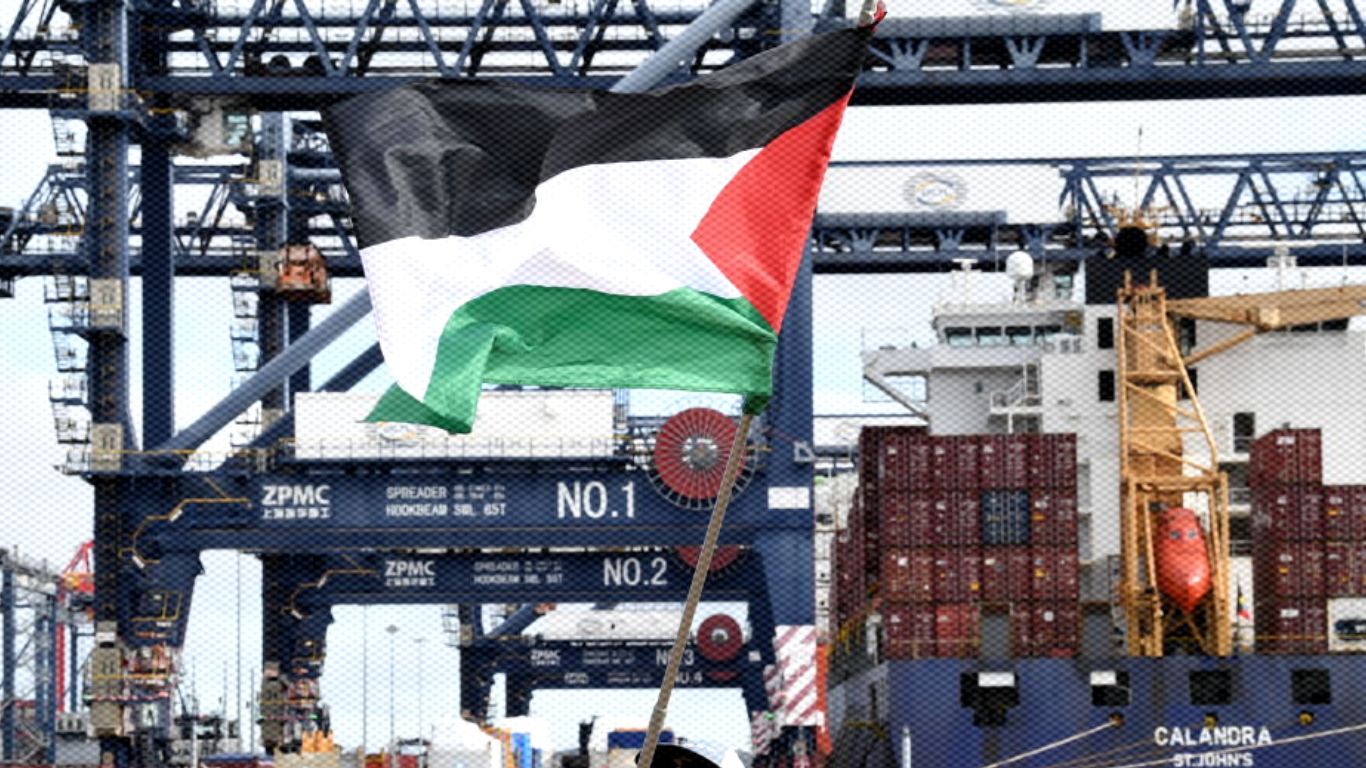
Our legal actions are embedded in the Palestine solidarity movement. They would be ineffective without public campaigns and direct action, like protests, port blockades and union strikes. Collective mobilising has at times managed to delay or reroute ships suspected of carrying military cargo. Campaigns targeting logistics firms have led some companies, like Maersk and Lufthansa to revise policies on transporting certain goods, though they have later reversed those decisions.
Finally, to fully respect third-state legal obligations and to properly prevent further genocide and other crimes committed against the Palestinian people, European States need to impose a full weapons embargo on Israel. Until then, we will continue our collective mobilisation and apply every possible strategy to achieve this. The pressure is mounting.
ELSC Crimes & Complicity Team
The Crimes & Complicity Team at ELSC is committed to ending impunity for state, corporate, and individual actors that facilitate Israel’s violations of Palestinian rights.
The ELSC Blog is a space for analysis, reflection, and debate within the movement.
The views expressed in individual contributions are those of the authors and do not necessarily reflect the position of the European Legal Support Center (ELSC) as an organisation. All submissions are subject to editorial review and, where necessary, legal review. ELSC retains final editorial control over published material.
Contribute to the Blog
We encourage contributions that provide legal analysis, political reflection, strategic insights, movement experiences, interviews, and briefings relevant to Palestine solidarity and anti-Palestinian repression across Europe.