This House believes Israel is an apartheid state engaged in genocide
LEGAL VICTORY
Oxford Union restores susan abulhawa’s uncensored speech
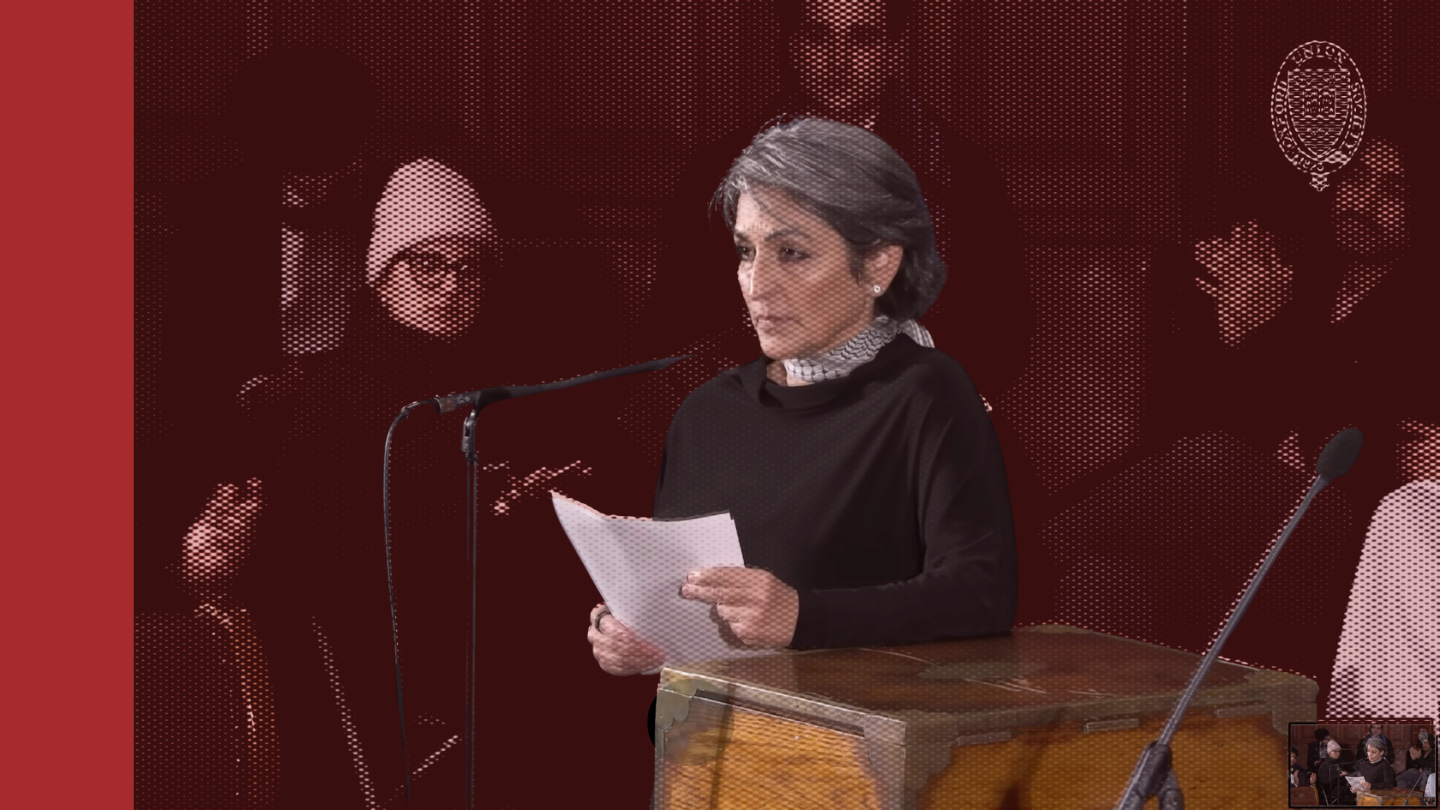
Palestinian author susan abulhawa, represented by The European Legal Support Center (ELSC) has won her two-year fight against the Oxford Union’s censorship of her speech. Her November 2024 address, which the Union cut without her consent, is now back in full on its official channels. susan abulhawa’s speech belongs in the historical record of Israel’s livestreamed genocide in Gaza. Future generations will look back on it as an archive that helps them make sense of this dark moment in human history.
On 28 November 2024, susan abulhawa spoke in favour of the motion at the Oxford Union, alongside Mohammed El-Kurd and Miko Peled. The Union posted her speech on its YouTube channel on 5 December. It went viral, attracting more than 250,000 views within a few days. On 13 December, the Union quietly removed it and replaced it with a version that cut nearly two minutes. abulhawa had accepted the invitation on the condition in writing that her speech would not be edited.
It justified the cuts by claiming the passages risked criminal prosecution for stirring up racial or religious hatred. No one asked abulhawa to explain or source a single word before they cut her speech.
The five passages removed by the Oxford Union, and now restored, are:
- “…and in the 1980s and ’90s, Israeli soldiers had left booby-trapped toys in southern Lebanon that exploded when excited children picked them up.”
- “…if Palestinians were systematically raping Jewish doctors, patients, and other captives with hot metal rods, jagged and electrified sticks, and fire extinguishers, sometimes raping to death, as happened with Dr. Adnan Al-Bursh and others.”
- “…these notions of entitlement and privilege, of being divinely favoured, blessed, or chosen.” (In full: “I came in the spirit of Malcolm X and Jimmy Baldwin, both of whom stood here and in Cambridge before I was born, facing finely dressed, well-spoken monsters who harboured the same supremacist ideologies as Zionism — these notions of entitlement and privilege, of being divinely favoured, blessed, or chosen.”)
- “You carved out our hearts because it is clear you do not know how to live in the world without dominating others.” (Preceded by: “And I also came to speak directly to Zionists here and everywhere.”)
- “You have crossed all lines and nurtured the most vile of human impulses… and they are seeing the reality of who you are, who you’ve always been.”
The deleted passages were labelled “antisemitic tropes,” but abulhawa’s reference to booby-trapped toys left in southern Lebanon was recorded at the time by the United Nations1 and has been referred to by the UK Foreign and Commonwealth Office in its travel advice2. Her account of the sexual torture of Palestinian detainees, including the case of Dr Adnan Al-Bursh, the Gaza surgeon who died in Israeli custody in April 20243, matches the March 2025 finding of a UN Commission of Inquiry that sexual violence against Palestinian detainees is widespread and systematic4. Her criticism of Zionism is a protected belief under UK law, and she was explicit that her criticism of Zionism is not an attack on Judaism.
This is why this outcome matters. For 78 years, Palestinians have had their history disputed, rewritten, and erased. Villages have been bulldozed and renamed, archives seized, and survivors’ accounts dismissed as propaganda. Edward Said described this as the denial of Palestinians’ “permission to narrate.”5
The Union’s edit made the same demand: Palestinians are routinely told they may speak only as perfect victims, measured and grateful and careful not to cause discomfort. susan abulhawa refused to accept those terms, and refused to let the world forget what Palestine has endured, and she was right to refuse.
Her case is not isolated. Across Britain, Palestinians and those who stand with them face police investigations, institutional disciplinary processes, cancelled events, and quiet edits, often justified by vague allegations of criminality that nobody ever tests. This case shows what happens when they are tested. The allegation collapsed under scrutiny, and the speech has been restored.
Watch susan abulhawa’s full, uncensored speech
susan abulhawa said:
“Our greatest powers live in our voices; our indigenous stories; our intellectual and creative labor; our love for our ancestors, for each other, and for our children; and the truth of our struggle for liberation. I’m pleased that we reached a just agreement that led to my unedited speech being posted back on the Oxford Union’s channels along with other speakers and debaters.”
Tasnima, UK Advocacy Manager ELSC, said:
“Erasing Susan’s words didn’t change the reality of this genocide but served to conceal it. Susan’s testimony is part of the historical record, and it belongs there in full. ELSC will continue to defend Palestine solidarity advocates that institutions try to silence.
—–
- Annex to the Note verbale dated 16 November 1998 from the Permanent Mission of Lebanon to the United Nations addressed to the Secretary-General. Available at: https://www.un.org/unispal/document/auto-insert-180386/
↩︎ - Foreign and Commonwealth Office, Memorandum on landmines in South Lebanon, 29 September 2000, published in House of Commons Foreign Affairs Committee, First Special Report of Session 2000–01, HC 78, Appendix 12. https://publications.parliament.uk/pa/cm200001/cmselect/cmfaff/78/7828.htm
↩︎ - https://www.ohchr.org/en/press-releases/2024/05/un-expert-horrified-death-gazan-orthopedic-surgeon-israeli-detention
↩︎ - UN Independent International Commission of Inquiry on the Occupied Palestinian Territory, including East Jerusalem, and Israel, “More than a human can bear”: Israel’s systematic use of sexual, reproductive and other forms of gender-based violence since 7 October 2023, A/HRC/58/CRP.6, 13 March 2025. Available at: https://www.un.org/unispal/wp-content/uploads/2025/03/Report-of-Independent-International-Commission-of-Inquiry-on-the-Occupied-Palestinian-Territory-13-March-2025.pdf
↩︎ - Edward W. Said, “Permission to Narrate,” London Review of Books, Vol. 6 No. 3, 16 February 1984, pp. 13–17; republished in Journal of Palestine Studies, Vol. 13 No. 3, Spring 1984. Available at: https://www.palestine-studies.org/en/node/38869 ↩︎