Bea Foster v UK Secretary of State for Culture, Media and Sport
Landmark legal case seeks to challenge UK government’s use of IHRA definition of antisemitism to suppress Palestine advocacy
On 9th July 2026, the European Legal Support Centre (ELSC) issued a landmark human rights claim against the UK Secretary of State for Culture, Media and Sport, in the County Court under the Human Rights Act 1998, challenging the UK government’s decision to rely on the International Holocaust Remembrance Alliance (IHRA) definition of antisemitism, which has been widely criticised as a tool of political repression-to justify pressurising Bea Foster, a longstanding community activist into stepping down from the charity she helped build, after she expressed solidarity with Palestine on her personal social media.
This case is part of ELSC’s wider work defending individuals and organisations who face legal and institutional pressure for speaking out on Palestine and challenging the misuse of legal and policy frameworks in ways that restrict freedom of expression.
Who is Bea Foster?
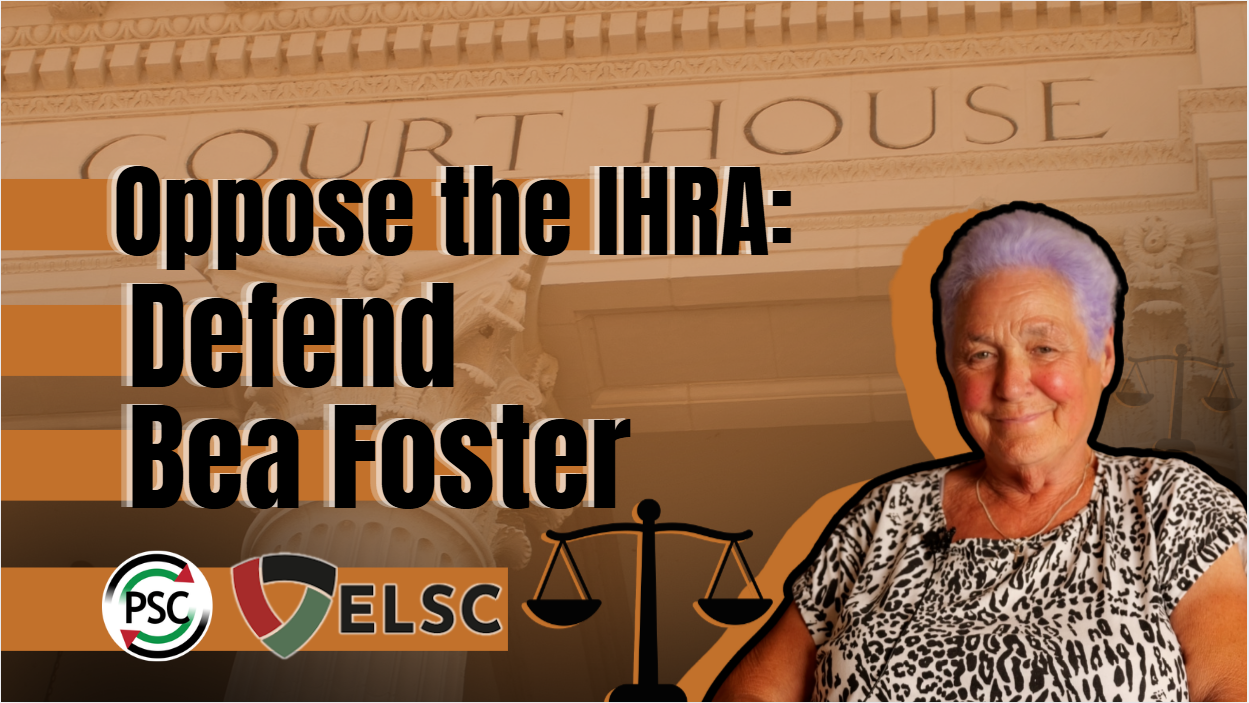
Beatrice (“Bea”) Foster is a 72-year-old Methodist preacher, interfaith organiser, and committed Palestine solidarity activist.
She regularly visits Palestine, including recent visits with Christian delegations supporting olive harvests, and is a long-standing member of the Palestine Solidarity Campaign.
Bea is also a founding member of Building Bridges Burnley (BBB), an interfaith anti-racist organisation working to foster community cohesion and dialogue. She served as a trustee of BBB for over 20 years, dedicating much of her life to grassroots anti-racist and humanitarian work in her local community.
What happened?
In November 2024, Building Bridges Burnley received the King’s Award for Voluntary Service, one of the UK’s highest honours for community organisations.
Shortly afterwards, Bea was doxxed and targeted by the Jewish Chronicle, a UK based Zionist newspaper, concerning Facebook posts shared by Bea in which she expressed solidarity with Palestine and criticised Israel’s crimes against the Palestinian people.
The Department for Culture, Media and Sport (DCMS) subsequently initiated an investigation into the charity and indicated that BBB risked losing its award unless Bea stepped down as trustee.
Bea was not given a fair opportunity to respond to the allegations. Faced with the threat of serious consequences for the organisation she helped build, she resigned in February 2025 to protect the charity.
She has consistently rejected the claim that her political speech on Palestine amounts to “antisemitism”.
Despite this, in March 2025 DCMS recommended and approved that Bea be excluded from involvement with the charity for a period of three years.
In subsequent correspondence, DCMS confirmed it relied on the IHRA definition of antisemitism, specifically “Drawing comparisons of contemporary Israeli policy to that of the Nazis” to characterise Bea’s posts as antisemitic.
The legal challenge
ELSC’s claim argues that the government acted unlawfully and in breach of Bea Foster’s fundamental rights under the European Convention on Human Rights, as incorporated by the Human Rights Act 1998.
Article 10 – Freedom of Expression
Bea’s posts and public political speech on Palestine are protected expression. The claim argues that criticism of state conduct, including political comparisons that, cannot automatically be treated as antisemitic, and that the decision to penalise her was neither lawful nor proportionate.
Article 11 – Freedom of Association
Bea’s role as a trustee of BBB was part of her protected right to freedom of association. The claim argues there was no lawful basis for state pressure that resulted in her removal from a charity she helped found, and that the decision was taken outside proper legal authority and for an improper purpose.
Article 14 – Non-discrimination
The claim further argues that Bea was treated less favourably because of her political beliefs and her solidarity with the Palestinian people. It also challenges the discriminatory impact of relying on the weaponised IHRA definition in a way that risks capturing legitimate political speech on Palestine and reclassifying it as antisemitism.
Bea is seeking a court order quashing the government’s decision, a declaration that it was unlawful, and damages.
Why this case matters
The IHRA framework has been used to extend the concept of antisemitism beyond racism against Jewish people to include criticism of the State of Israel as a political entity, and that its examples risk repressing political speech by framing certain descriptions of Israeli policy such as references to apartheid, settler colonialism, or the Nakba as potentially “antisemitic”.
Opposing the misuse of the IHRA definition is therefore essential to protecting fundamental rights to freedom of expression and association, and to ensuring that solidarity with the Palestinian people cannot be silenced through administrative or institutional pressure disguised as anti-racism policy.
It also forms part of the growing legal and public challenge to the misuse of the IHRA definition, particularly where it is used to conflate criticism of the State of Israel with antisemitism.
If such decisions go unchallenged, they risk setting a precedent where individuals can be penalised or removed from public life for expressing solidarity with the Palestinian people, and ultimately erase Palestine from the public consciousness.
The ELSC is supporting Bea Foster to bring legal action against the UK government and the Secretary of State for Culture, Media and Sport, Lisa Nandy, challenging the use of the IHRA definition of antisemitism in a way that has infringed upon her fundamental human rights. The IHRA must be understood within the wider context of growing efforts to restrict and punish advocacy for Palestinian rights. Rather than simply addressing discrimination, its application has increasingly been used to conflate criticism of the State of Israel with antisemitism, resulting in lawful political expression being investigated, sanctioned and suppressed.
Bea is one of many Palestine advocates who have faced institutional repression in recent years. Our ‘Index of Repression’ has documented cases across universities, the NHS, charities, workplaces and public institutions, where people have experienced investigations, disciplinary action, dismissal and exclusion because of their solidarity with Palestine.
Those who continue to rely on the IHRA definition to restrict political expression should be aware that its use is now subject to legal challenge. ELSC will continue to defend the fundamental rights of the Palestine solidarity movement and challenge attempts to silence solidarity.”
Donate to the campaign to fund the legal fightback: https://donate.palestinecampaign.org/oppose-the-IHRA?utm_source=website?utm_medium=campaign_page?utm_campaign=oppose-IHRA?utm_content=CTA